



Asset Management Checklist: Key Takeaways
- Standardized asset checklists improve reporting accuracy, tracking and operational visibility
- Effective equipment checklists include identification details, maintenance tracking, condition assessments and corrective actions
- Digital asset management reports provide real-time visibility and reduce administrative workload
From vehicles and machinery to IT equipment and safety gear, most businesses depend on physical assets to keep operations running.
A standardized asset management checklist helps optimize inspections, maintenance, reporting and tracking.
Here’s what businesses should know about building a more consistent asset management process:
- The importance of standardization in asset management
- The key components of an effective equipment checklist
- How to implement a standardized process
- The difference between digital and paper asset management reports
Want to simplify inspections and improve asset visibility?
Try doForms for free
Why Standardization Matters In Asset Management
Businesses manage assets differently across teams, departments or locations. Warehouse employees may use spreadsheets. A construction crew may still complete equipment inspections on paper forms.
When information is spread across different systems or paper records, visibility quickly becomes inconsistent.
A standardized asset management checklist brings asset inspections, maintenance tracking, equipment status updates, reporting, incidents and compliance into a single workflow.
Improves Reporting Accuracy
When every employee uses the same asset checklist, your organization collects consistent, detailed information about:
- Operational status
- Maintenance priority
- Inspection score
- Repair category
- Downtime estimate
That makes it easier to spot recurring maintenance problems before they create larger operational issues. It also reduces the risk of downtime.
Reduces Missed Maintenance
Without standardization, preventive maintenance tasks often get overlooked.
A standardized checklist ensures employees verify key elements like safety components, calibration readings, battery conditions and wear and tear.
In many cases, teams can identify problems before they turn into expensive breakdowns.
Enhances Accountability
When workflows are standardized, every inspection or update is tied to a user, location and timestamp.
Combined with supporting documentation, these records make it easier to understand what happened and who handled it.
Simplifies Compliance
Many industries must maintain detailed inspection and maintenance records to comply with various standards.
These may include Occupational Safety and Health Administration (OSHA), Department of Transportation (DOT), the U.S. Environmental Protection Agency (EPA) and the U.S. Food and Drug Administration (FDA) regulations, along with other industry-specific compliance requirements.
Standardized asset management reporting creates reliable audit trails and simplifies compliance preparation.
Key Elements Of An Equipment Checklist
A useful asset checklist does more than simply track inventory. It lists existing items, but also helps evaluate their condition and performance.
To meet these criteria, it should contain a few key sections.
Asset Identification Information
This part includes the asset name, its location, equipment ID, serial number, barcode or QR code, manufacturer information, and the name of the employee to which the asset is assigned.
Operational Status
Here, you must state if the asset is fully operational or it has issues, needs repairs or is under maintenance.
Teams can quickly see whether equipment is available, under repair, or temporarily out of service.
Condition Assessment
A standardized condition section allows businesses to monitor deterioration over time and create reliable asset management reports, listing:
- Physical damage
- Corrosion
- Fluid leaks
- Electrical issues
- Safety hazards
- Performance inconsistencies
- Missing components
Preventive Maintenance Checks
Preventive maintenance sections help teams complete routine checks more consistently to ensure prolonged asset lifespan.
These can include various tasks, such as lubrication checks, filter replacements, pressure verification or cleaning procedures.
Photo Documentation
Employees can upload damage photos, maintenance evidence, completed repairs and before-and-after comparisons.
This improves transparency, simplifies issue resolution and creates more reliable asset management reports, reducing disputes.
Corrective Action Tracking
A strong checklist includes fields for recommended actions, timeline, assigned technician and follow-up deadlines. This prevents inspection findings from getting ignored.
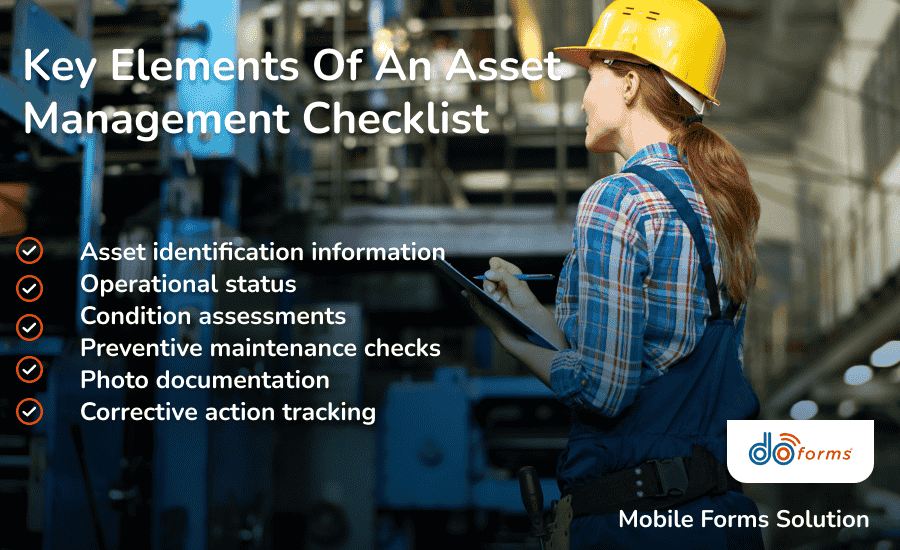
A good asset management checklist includes several essential sections
How To Implement a Standardized Checklist
Standardization only works when the process becomes part of daily operations.
- Standardize inspection procedures across all departments and locations.
- Create role-specific templates for equipment inspections, facility audits and maintenance reporting.
- Make checklists accessible on mobile devices for field and remote teams.
- Use required fields and structured responses to improve reporting accuracy.
- Automate notifications, approvals and follow-up actions for failed inspections or maintenance issues.
- Store all inspection records and asset management reports in a centralized system.
- Train employees on proper checklist usage and reporting expectations.
- Regularly review asset management reports to identify recurring issues and operational trends.
Digital Asset Management Checklists vs. Paper
Many businesses still rely on paper forms, but managing large volumes of records manually creates additional administrative work.
In addition, they require storage space that can be expensive long-term, especially for businesses managing large volumes of inspection records, maintenance logs and compliance documentation across multiple locations.
Paper records are also harder to organize, retrieve and protect from damage.
Advantages Of Digital Asset Checklists
A digital asset management checklist provides several operational advantages.
- Your teams can submit inspection data instantly from the field, so you get instant visibility into equipment condition and maintenance issues.
- Digital platforms can automatically generate inspection summaries, maintenance logs and compliance reports, improving reporting and reducing admin work.
- With digital forms, you get better data accuracy due to the use of required fields, conditional logic, drop-down selections and automated calculations.
- All records remain stored securely in one connected system, allowing you to retrieve historic data, maintenance history, repair documentation and audit records.
- Mobile checklists allow employees to complete inspections faster without returning to the office, boosting productivity and reducing downtime.

Digital asset checklists offer a number of advantages
Create Asset Management Checklists With doForms
doForms is a modern mobile forms solution, which helps businesses digitize asset management workflows with customizable mobile forms.
With doForms, your teams can:
Complete asset checklists from any mobile device.
- Upload photos, signatures and GPS data.
- Generate asset management reports automatically.
- Track inspections in real time.
- Store records securely in the cloud.
- Reduce paperwork and manual entry (Read more about mobile vs. paper forms)
doForms can be a great resource if you’re managing field service teams, fleet operations, construction equipment or safety compliance programs.
This can be especially useful for teams working across multiple locations or remote job sites, as doForms helps you simplify data collection and improves operational visibility.
Ready to improve your asset management?
Try doForms for free
Asset Management Checklist: FAQs
What is an asset management checklist?
An asset management checklist is a form that helps businesses track equipment condition, maintenance activities, inspections and operational status.
What are the benefits of standardization in asset management?
Standardization ensures that all teams use the same reporting and inspection procedures, improving consistency and accuracy.
What is an asset management report?
An asset management report summarizes inspection data, maintenance history, performance issues and operational trends, so companies manage assets more effectively.
How do digital asset checklists improve reporting?
Digital systems can automate document workflows, reduce manual entry errors, improve data accuracy and provide real-time operational visibility.
Can mobile forms improve field inspections?
Yes. Mobile forms allow employees to complete inspections, upload photos and submit reports directly from smartphones or tablets in real time, so you’re always updated about what’s going on.
Ready to take control of your assets with doForms?
Book a doForms demo