




Safety Observation Checklist Form: Key Takeaways
- Safety observation checklist forms help businesses identify hazards before accidents, injuries or compliance violations occur
- Effective checklist forms include clear descriptions, location details, risk levels, supporting evidence and corrective actions
- Digital checklist forms reduce paperwork, improve reporting speed and boost visibility and accountability
A serious Occupational Safety and Health Administration (OSHA) violation can cost you up to $16,550 per violation, while willful or repeated violations can reach $165,514.
Fortunately, many workplace hazards can be identified before they lead to incidents.
Regular safety observations make it easier to spot hazards, document concerns and address issues before they escalate.
In this guide, you’ll learn:
- Why safety observation checklist forms are important
- Key elements of a safety observation checklist form
- Examples of workplace safety observations reports
- How to complete a safety observation form
- The benefits of going digital
Looking to create safety observation checklist forms?
Try doForms for free
Why Safety Observation Checklist Forms Matter
The goal of safety observations is to identify risks before they cause injuries, delays, or compliance issues.
Prevent Workplace Injuries
Proactive hazard identification is one of the most effective ways to reduce workplace incidents, according to OSHA.
Use safety observation checklist forms to report oil spills, missing machine guards, workers not wearing PPE, improper lifting techniques and blocked emergency exits.
Improve Safety Awareness
Using safety observation checklist forms encourages employees to actively look for hazards during daily work activities.
Over time, they become more comfortable reporting concerns and discussing safety issues openly.
Support OSHA Compliance
Safety documentation is critical to prove your business is compliant with standards and regulations. It contains organized records showing:
- Hazard identification
- Corrective actions
- Employee training
- Inspection history
- Incident prevention efforts
Reduce Operational Downtime
Accidents and personal injuries disrupt operations, causing delays, equipment shutdowns and productivity losses.
Businesses may also face insurance claims, legal costs and reputational damage following serious incidents.
A safety observation checklist helps you stay protected.
Strengthen Safety Culture
Employees are often more willing to speak up when they see safety concerns taken seriously.
This improves trust between workers and leadership while supporting the idea that safety is everyone’s responsibility.

Safety observation checklist forms offer valuable advantages for your team and business
Key Elements Of An Effective Safety Observation Checklist Form
Every good checklist should have several key sections:
- Observation date & time: Records exactly when the safety issue or observation occurred.
- Location information: Specifies the place where the hazard was identified, so supervisors can check it out quickly.
- Checklist categories: Organizes observations into sections such as PPE compliance, equipment safety, housekeeping or fire safety.
- Hazard description: Explains what was observed, why it is considered unsafe and who may be affected by the risk.
- Risk level assessment: Helps classify hazards as low, moderate, high or critical risk and prioritize the ones that are most important.
- Photos & supporting evidence: Provides visual evidence to support the observation.
- Corrective action recommendations: Lists actions to resolve the issue, such as equipment replacement, retraining or updated procedures.
- Follow-up tracking: Shows the status of corrective actions using labels such as open, in progress, resolved or escalated to ensure hazards are addressed.
Examples Of Safety Observation Checklist Forms In The Workplace
Safety observation checklist forms vary by industry as they reflect different operational risks. Below you’ll find a few illustrations of what they may include.
Construction Safety Observation Checklist
- Observation: Worker on scaffolding not using fall protection equipment above six feet.
- Checklist category: Fall protection compliance.
- Risk: Potential fall injury or fatality.
- Corrective action: Stop work immediately and require the worker to use a proper harness before resuming activity.
Warehouse Safety Observation Checklist
- Observation: Stacked inventory boxes blocking the emergency exit.
- Checklist category: Staying prepared for a potential emergency.
- Risk: Delayed evacuation during emergencies.
- Corrective action: Remove materials and place no-storage signs near exits.
Manufacturing Safety Observation Checklist
- Observation: Machine guard removed from cutting equipment during operation.
- Checklist category: Machine safety.
- Risk: Potential hand injury or amputation.
- Corrective action: Reinstall safety guard before operation or lock out dangerous equipment.
How To Complete A Safety Observation Checklist Form
Clear, accurate reporting helps supervisors understand the issue and respond appropriately.
Observe Carefully
Collect accurate information about the situation, listing unsafe conditions or actions, environmental risks, equipment issues or PPE violations.
Complete Required Fields
Fill out required sections, choosing from dropdown menus or using checkboxes, to ensure you’ve not missed critical information.
Use Objective Language
Avoid emotional wording. Instead, focus on providing specificity. Objective language improves professionalism and reduces conflict.
Attach Supporting Evidence
Whenever possible, include photos, videos, inspection notes and witness statements.
Recommend Corrective Actions
Suggest steps that can lead to improvement, whether additional employee training, updated procedures, area cleanup or supervisor review.
Submit The Checklist Form Immediately
On-time reporting ensures management receives safety observations fast, so they can respond as soon as possible.
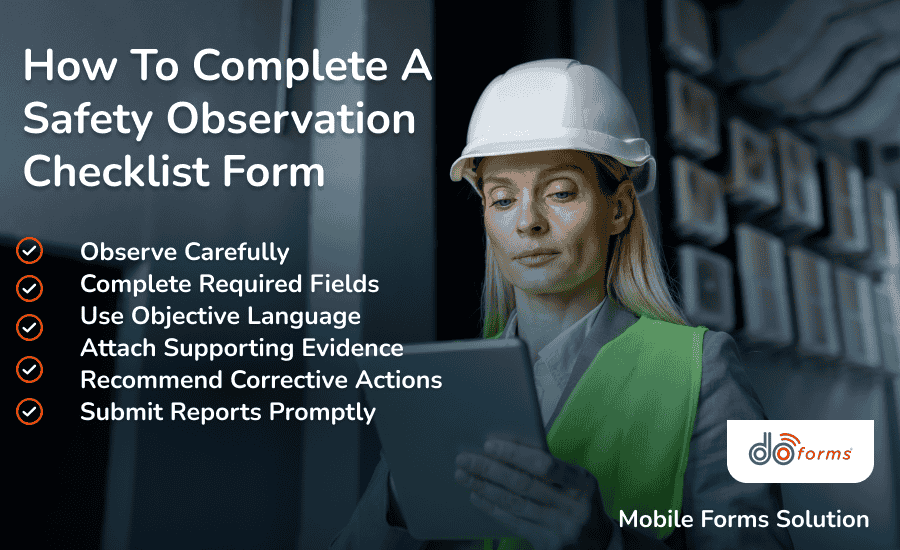
Following a consistent reporting process helps ensure safety concerns are documented accurately and addressed in a timely manner
Digital Safety Observation Checklist Forms vs. Paper Checklists
Many organizations still rely on paper checklists despite the limitations they create.
Paper checklist forms often sit in trucks, offices or filing cabinets before review. You can easily misplace or lose them, and they may require extra space to store.
Digital checklist forms are submitted instantly from mobile devices, ensuring better accuracy, real-time visibility across multiple job sites, faster response and improved accountability.
Teams can complete checklist forms directly from construction sites, warehouses, vehicles, hospitals and manufacturing floors.
Safety observation forms also facilitate keeping compliance documentation, making it easier to retrieve what you need for inspections and audits.
Reports remain searchable, organized and securely stored in the cloud.
In addition, digital workflows can automate notifications, approvals, and report routing, saving time and improving operations.
Use doForms To Create Efficient Safety Observation Checklist Forms
Managing workplace safety with paper checklists can be challenging due to delays, inaccuracies and extra administrative work.
doForms is a mobile forms solution that helps you modernize safety observation, so your field teams feel protected every step of the way.
With doForms, your teams can create custom safety observation checklist templates and fill them out on their smartphones or tablets.
They can also take photos to illustrate the hazard or how the issue has been addressed.
Additional capabilities include:
- Capturing signatures and GPS data in real time
- Automating notifications and report routing
- Tracking corrective actions in real time
- Accessing reports from any location
Digitize your safety observation checklist forms.
Try doForms for free
Safety Observation Checklist Form: FAQ
What is a safety observation checklist form?
A safety observation checklist form is a document that helps identify unsafe behaviors, hazardous conditions or positive safety practices in the workplace.
Why are safety observation checklist forms important?
They help your business prevent accidents, improve compliance, strengthen safety culture and reduce operational risks.
What should a safety observation checklist form include?
A checklist form should include:
- Date and time
- Location
- Hazard categories
- Observation details
- Risk level
- Corrective actions
- Photos or signatures
- Follow-up tracking
What industries use safety observation checklist forms?
Construction, manufacturing, logistics, healthcare, utilities and warehousing commonly use safety observation checklist forms.
How do mobile forms improve workplace safety?
Mobile forms allow employees to complete safety observation checklist forms instantly, attach photos, track follow-up steps and improve communication between field teams and leadership.
Ready to simplify workplace safety reporting?
Book a doForms demo